
Wheeler County Arrest Warrants Explained
An arrest warrant is a signed court order. It tells an authorized officer to arrest a person and bring them before the issuing authority. For lower-court process in Texas, Article 45A.104 requires a sworn complaint or a probable-cause affidavit. The signed order names the offense, identifies the person or gives a sufficient description, and carries the judge's signature. Wheeler County publishes no countywide warrant search, no local number format, and no bond schedule on its public pages. One court's case search cannot confirm every district, JP, municipal, or outside-jurisdiction warrant.
JP1 Publishes Arrest Warrant Authority
Justice of the Peace Precinct 1 posts a service sheet covering arrest, search, and blood-warrant services. That shows a published magistrate function. It is not a public list, and it does not mean JP1 holds every Wheeler County arrest warrant. The issuing court decides which office keeps the case. For a lower-court question, try the JP1 court page, or ask JP2 if the paperwork names Shamrock or Precinct 2. District-court records go through a separate clerk.
Inside a Wheeler County Arrest Warrant
Ask about the fields, not a sample. The order and docket may show the issuing authority, the offense, a case number, the direction to the officer, issue and return dates, and a bond entry if one has been set. Wheeler County publishes no sample warrant and no local number pattern. These are record fields to request, not a claim that any local portal displays them.
| Case number | Use it to ask the correct court for the existing file; no local format guide is posted. |
|---|---|
| Issuing authority | The judge or magistrate who signed or ordered the process. |
| Person and offense | Name or description plus the alleged offense; protected identifiers may be redacted. |
| Order terms | Direction to an authorized officer and command to bring the person before court. |
| Dates and return | Issue, service, or return information recorded by the court or officer. |
| Bond and disposition | Ask the court what is set and whether the warrant was recalled or served. |
District Court Records Use a Clerk
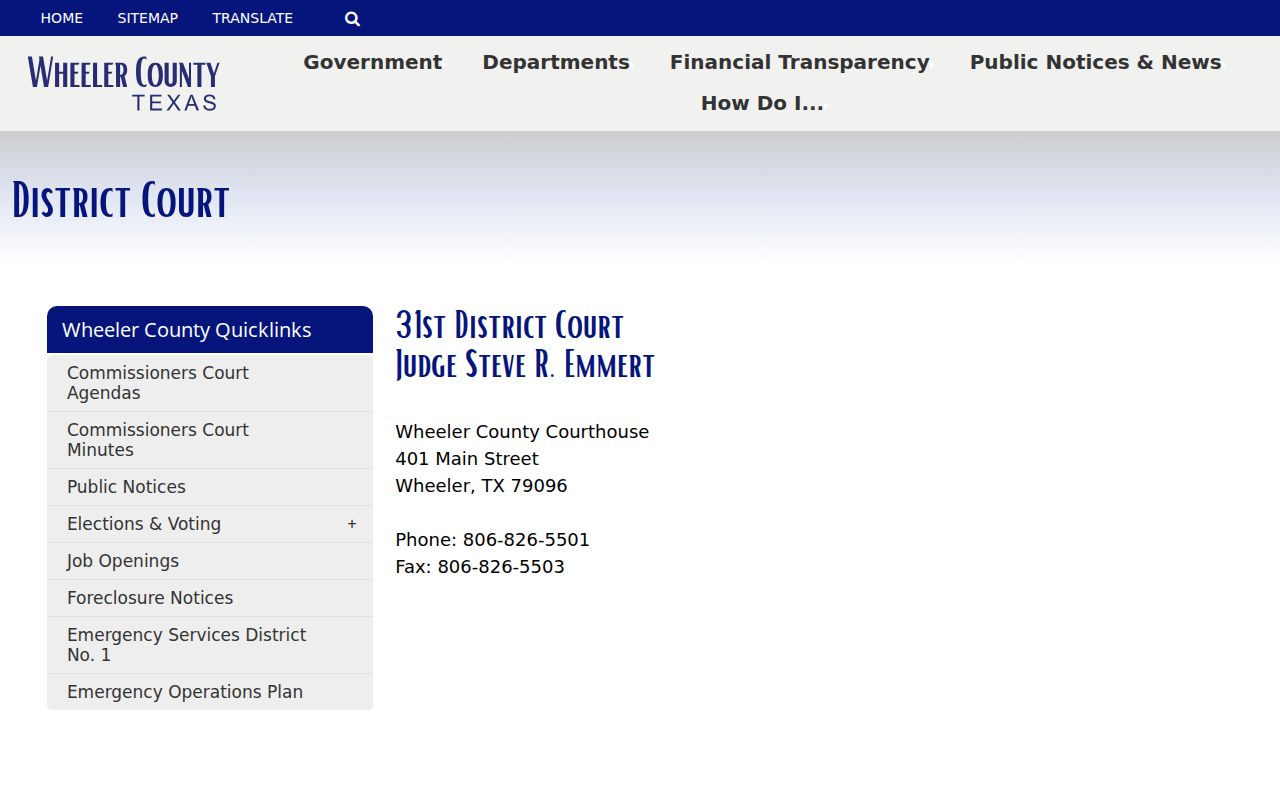
For a felony or any 31st District Court matter, the Wheeler County District Clerk is the records contact. The County Clerk runs a separate county-level record route. A person held at the jail does not shift a district case into a JP docket. A county clerk page is not a warrant database. The District Court contact page names the courthouse court and how to reach it:
Ask the Wheeler County District Clerk which non-confidential docket or warrant record exists for the case. The clerk keeps the district court's files:
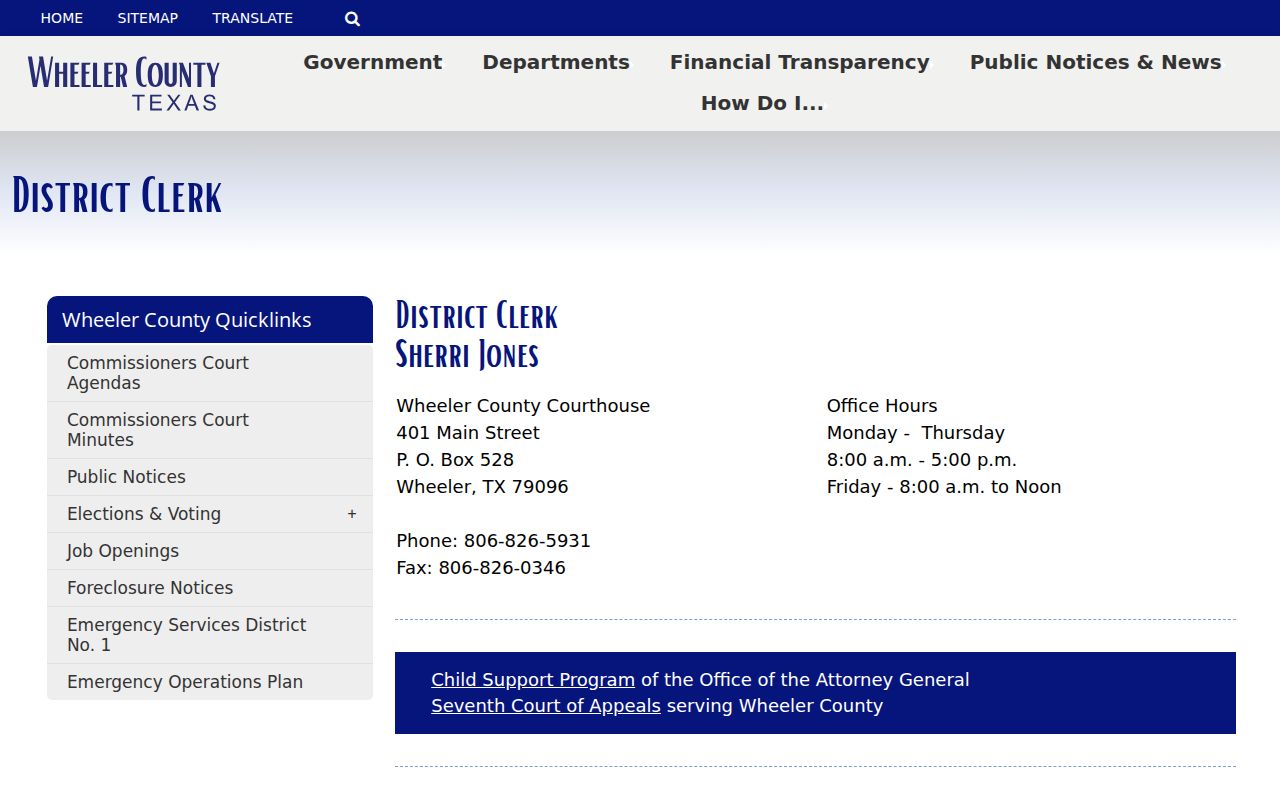
Use that Wheeler County clerk page for its records route, then confirm whether the specific item is public.
Serving Arrest Warrants in Wheeler County
The Wheeler County Sheriff and Jail is the main county law-enforcement contact. The county also lists Precinct 1 and Precinct 2 constables. Texas law lets a municipal peace officer or marshal serve municipal process. No county page says which officer receives a particular warrant, so say an officer "may serve" it unless the order names the agency. Call the issuing court about the order itself. Call the Sheriff or Jail about custody, surrender, and bond logistics. The jail page posts no intake hours, accepted payment methods, or walk-in warrant window.
Wheeler County Service Assignments
The listings give names and places. Precinct 1 Constable Mack Marshall appears at the Wheeler County Jail, 304 Alan Bean Boulevard. Precinct 2 Constable Jeff Shortnacy is listed at the Shamrock JP2 address. The sheriff page carries the county jail contact. None of these pages assigns each warrant type to a serving officer. Ask the court which agency was directed to serve the order. A constable can help route the question, but the issuing court's status record still controls.
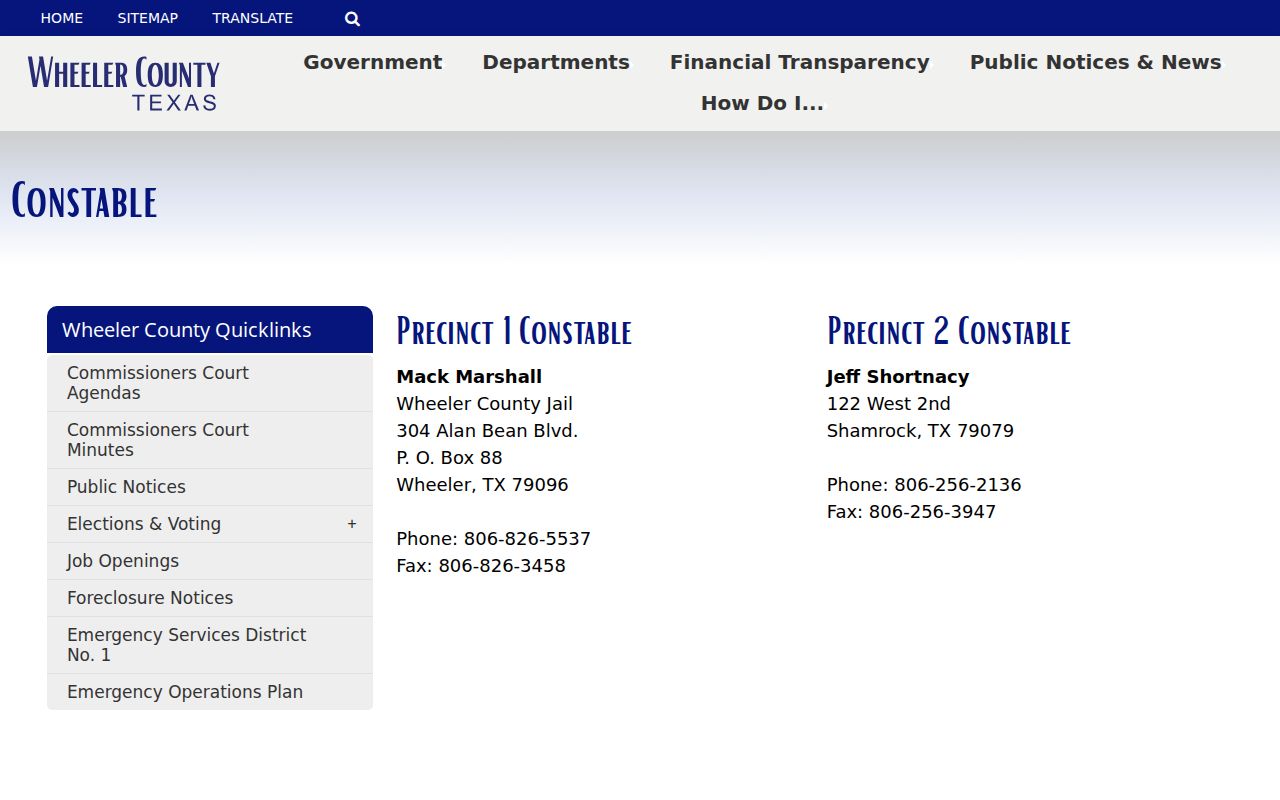
The public agency list supplies contacts, not a warrant-by-warrant service table.
Comparing Arrest, Summons, and Bench Warrants
These terms point in different directions. A summons sets an appearance without ordering arrest. An arrest warrant follows probable cause, while bench or FTA process follows a missed court duty. In Wheeler County, the court paper and the docket tell you which one applies.
| Feature | Arrest Warrant | Summons | Bench Warrant |
|---|---|---|---|
| What it orders | Arrest and bring before court | Appear at a stated time | Arrest tied to a missed duty |
| Basis | Probable cause | Notice to appear | Failure to appear or comply |
| Who controls next step | Issuing judge or magistrate | Court handling the case | Court that set the obligation |
| What to confirm | Status, bond, counsel, surrender | Date, court, and required response | Recall, hearing, or payment option |
Search Warrants Are Different Orders
A search warrant authorizes a search for described evidence. It does not direct an arrest just because it carries the word warrant. Texas Chapter 18 governs search-warrant rules, and the JP1 service sheet lists search warrants apart from arrest and blood warrants. A search affidavit may become public after execution, subject to sealing and other law. Do not use a search-warrant process to answer a question about an arrest order. Ask the court which document exists.
Bond Terms Depend on the Wheeler Issuing Court
Wheeler County posts no countywide bond schedule, no public surrender window, and no universal recall procedure for arrest warrants. JP2 publishes a not-guilty appearance-bond example equal to twice the suggested fine for its own cases. That figure is not a bond rule for district, county, or other JP matters. Ask the court named on the warrant for the current bond amount and the route to appear or seek a modification. A clerk can identify case records. A lawyer can advise on a safe response. The Sheriff answers custody questions but does not set the judge's case terms.
Handling a Wheeler County Arrest Warrant
Confirm the court and the case number first. Then ask whether the warrant is still active, whether bond has been set, and whether you must appear in person or file a motion. A lawyer can handle much of this for you. Counsel may contact the Wheeler County court about a hearing, a bond, a recall, or a planned surrender. The Sheriff or the Jail can walk you through custody steps as they stand today. Only the issuing judge controls the order, though. Keep written receipts and copies of every order. If the case sits in the 31st District Court, ask the District Clerk which public docket records exist; if it is a JP case, call that precinct court, since one Wheeler County search will not cover every record.
Important: Talk with a lawyer and confirm the court's current instructions before arranging surrender, posting bond, or asking for recall.