
Searching for a Warrant in Wheeler County
No public countywide sheriff warrant search was located. For a JP1 citation, the official Government Portal can search a case or ticket. For a JP2 matter, call the court in Shamrock. For district-court files, contact the District Clerk; for a county-court record, use the County Clerk route. A city ordinance matter may begin with city hall to identify the court.
Have the full name on the record, date of birth, case or ticket number, issuing agency, and approximate date ready. A case-search result may help locate the file, but it does not certify that a warrant is active or clear.
- Read the citation or court paper and identify its court, agency, and case number.
- Use JP1's official portal if the paper names Precinct 1; it searches last name with a ticket/case number or birth date.
- Call JP2 for a Shamrock or Precinct 2 case. Its page has no online warrant form.
- Call the Sheriff or Jail for county-held process and ask the issuing court to confirm status.
- For existing records not online, send a written Public Information Act request to the office likely to hold them.
Wheeler County Clerk Records Have a Separate Route
The Wheeler County Clerk maintains county-level records and publishes its own contact details and online-records link. That channel serves its court-record role; it is not a countywide warrant search and does not replace the Sheriff contact for service or custody questions. A request should name the record type and case identifier so staff can route it.
For a criminal case, first confirm which clerk holds the docket. The District Clerk serves the 31st District Court, while the County Clerk handles a separate set of county records. Do not treat a clerk's general records portal as proof of current warrant status.
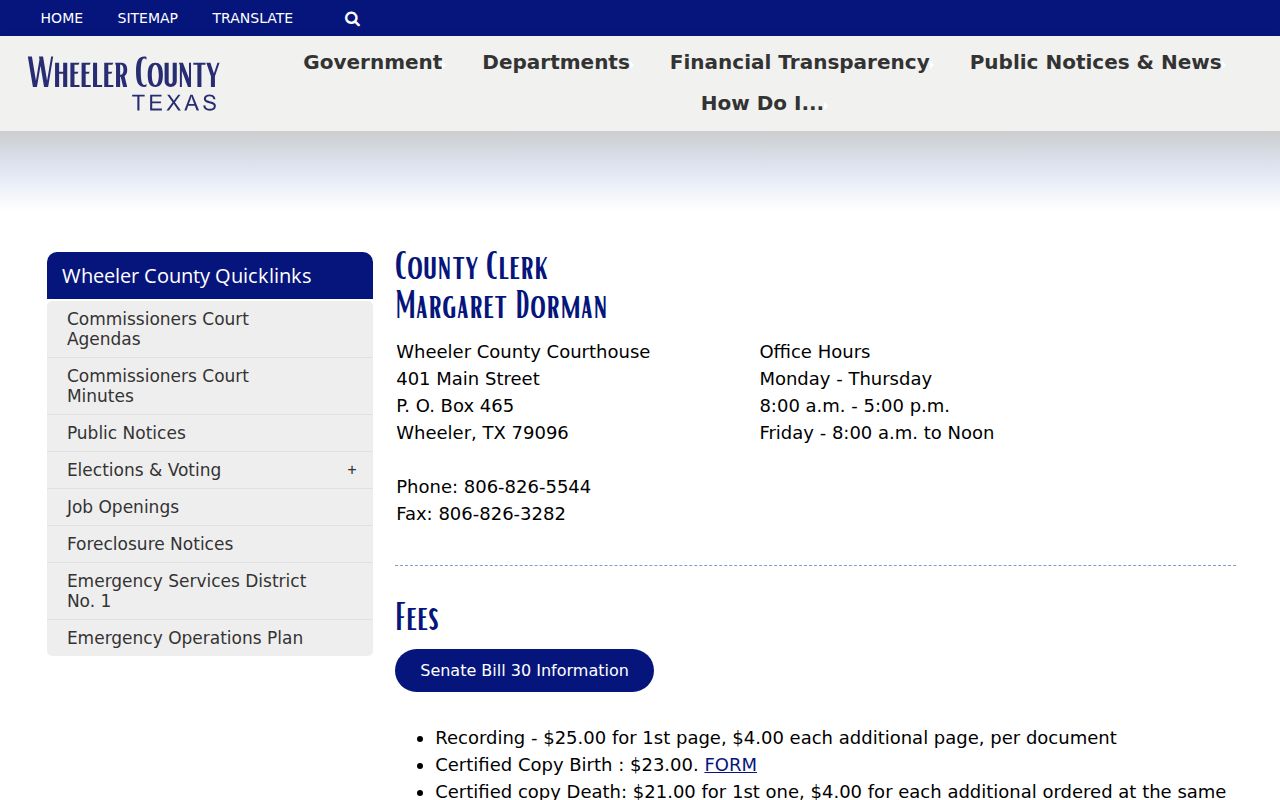
The County Clerk page shows a separate records route, not a warrant roster.
Wheeler Sheriff Contact Is Not a Warrant Search
The Sheriff's official page provides the Sheriff and Jail contact but no public warrant list, most-wanted roster, or warrant-search form. The county's separate public application did not expose a warrant interface in the reviewed material. A call is the documented public contact route; ask which case information the office can confirm and whether the issuing court must answer status questions.
The county does not publish public surrender hours, identity rules, or a bond window. Call before traveling to the jail or courthouse.
Warrant Search Fields Explained
The JP1 public case form shows two modes, not a county warrant search. In the first, last name pairs with ticket or case number. In the second, last name pairs with date of birth. The page gives no required-field markers, date format, partial-name rule, result limit, warrant filter, or update cadence.
| Field Label | Type | Required | Notes |
|---|---|---|---|
| Last Name | Text | Not stated | Appears in both search modes. |
| Ticket Number (Or Case Number) | Text | Not stated | Paired with last name in case-number mode. |
| Date of Birth | Date or text | Not stated | Paired with last name in birthday mode; format is not shown. |
| Search | Button | Not applicable | A separate control appears under each mode. |
JP2 Requires a Court Contact
JP2's county page lists a phone, fax, email, address, hours, and payment instructions, but no online warrant search. For a Shamrock-area citation, call with the ticket or case number and ask whether there is a warrant, an appearance setting, or a payment option. The court's fail-to-appear fine example is not a universal warrant bond.
The official JP2 page is the local contact and instructions source. Do not substitute a vendor payment form for status confirmation.
What a Wheeler County Search Shows
JP1's portal is a case lookup. The research review did not open a private result row, so no live field set or sample warrant can be claimed. Texas Article 45A.053 describes lower-court docket events, including offense, plea, warrant issue and return dates, trial setting, judgment, and appeal information.
| Local warrant number | Format not published; ask the issuing court for its case key. |
|---|---|
| Case and offense | Use the ticket or cause number to identify the docket and charge. |
| Issuing court | JP1, JP2, district, county, or city court as named on the paper. |
| Issue and return | Ask whether the order issued and what service event the court recorded. |
| Bond and status | Confirm amount, active status, recall, or satisfaction directly with the court. |
Texas FTA Search Is Separate
OmniBase can show a reported failure-to-appear or failure-to-pay license-renewal hold. It asks for a Texas driver's-license number and date of birth. DPS says license specialists do not have warrant information, and the portal's help page says the program is not a warrant database.
Use the official FTA portal for the license question only. Contact the reporting court for the underlying citation or warrant.
Where to Check Warrants in Wheeler County
The office depends on the record. JP1 holds its own citation and case material; JP2 handles its precinct cases; the District Clerk keeps 31st District Court records; and the County Clerk handles its separate county-level records. The Sheriff or Jail is the county law-enforcement contact. No one public source was found that searches all these courts.
For a city ticket, ask city hall which court has the case. Wheeler routes municipal-court questions to JP1, and Shamrock points to JP2 while using the county sheriff for police coverage.
Wheeler County Written Record Requests
The Texas Public Information Act lets a person request existing records in writing from the government office believed to hold them. Identify the court or agency, case or ticket number, date range, and specific non-confidential record sought. Ask for a fee estimate and retain proof of delivery. A request does not require the office to create a new list or provide legal research.
The Texas Attorney General explains accepted request methods and response steps in its public information request guidance. No Wheeler-specific warrant request form or fee was located.
Restricted Warrants and Access Rules
Public access has limits. Juvenile law-enforcement and arrest-warrant records have confidentiality rules. A law-enforcement body may withhold some information when release would interfere with an investigation or prosecution. Sealing orders and other statutory protections can also limit what a custodian provides.
Key Rules:
Texas Government Code Chapter 552 governs public-information requests and law-enforcement exceptions.
Texas Family Code Chapter 58 protects many juvenile records.
A blank result does not prove that no warrant exists; confirm status with the issuing court or Sheriff.